
 Overview
A transaction changes ownership on paper. Operationally, nothing changes unless you carry out a disciplined integration process. Revenue continues flowing through separate billing systems. Sales teams operate under different incentives. Finance can't produce a unified view. And what starts as a pragmatic deferral — "we'll migrate billing next quarter" — becomes structural drag that compounds quietly until it shows up in the numbers.
Integration failures typically trace back to five root causes:
Leadership Misalignment
Manual Operational Processes
Delayed Systems Migrations
Disconnected GTM Operations
Data Fragmentation.
By the time these problems are visible in performance metrics, unwinding them requires reversing decisions that have hardened into how the business operates.
The CFOs who consistently deliver on acquisition thesis treat integration as a system — not a series of one-off projects.
When acquiring a business, integration work starts between signing and closing. Use this window to build relationships with acquired leadership, map actual systems and workflows (not how they were described in diligence), draft Day 1 communications, align on decision rights, and identify key risks — customer renewals, retention vulnerabilities, product dependencies.
This pre-close integration preparation will set you up for a successful integration process over the next 90 days post-close.
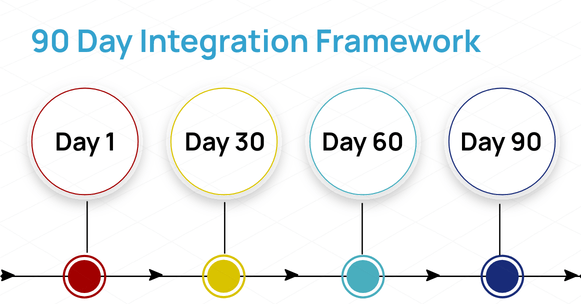
Quilt has developed a structured framework that breaks the first 90 days of integration into four sequential phases, each with defined outcomes that build the foundation for the next.


While integration is a full-leadership effort, the CFO sits at the center of execution. The behaviors that separate CFOs who consistently deliver are:
Transparent reporting to PE sponsors (unfiltered, not just the wins)
Decisive leadership transition decisions in the first 30 days
Cross-functional coordination with synchronized timelines, and relentless momentum — treating integration as the strategic priority it is and protecting it from the daily pull of business-as-usual operations.

Most integration stalls aren't a leadership or effort problem — they're a data infrastructure problem. Finance teams can't stabilize KPIs by Day 30, identify upsell opportunities by Day 60, or complete billing migrations by Day 90 when they're still manually reconciling fragmented data from multiple disconnected systems.
FinQore harmonizes financial, customer, and product usage data across acquired entities into a continuously updated, fully reconciled financial data foundation — purpose-built for PE-backed companies running high-frequency M&A.
When Quilt faced exactly this challenge — building reliable revenue visibility across multiple acquired brands without a dedicated data engineering team — they chose FinQore's fully managed solution, a unique combination of financial experts, software and AI Agents, over building a data solution in-house. The result:
Over 3x year-one ROI by eliminating the need for in-house data engineering, project management, finance, and outsourced services to build and maintain automation.
Automation-driven efficiency gains, freeing finance teams to focus on analysis, successful integration of acquired businesses and ultimately value creation from these investments.
Highest Impact ROI: Improved retention rates, sustained revenue growth, and ultimately higher valuations—powered by real-time revenue visibility and AI-powered insights that reduce risk and drive smarter investment decisions across all levels within the business.
Peace of mind for the CFO, serving as a “quasi-insurance policy” that ensures clean, reliable data—allowing financial leaders to focus on strategy, not data integrity concerns.
For the complete playbook — including pre-close checklists, cross-functional responsibility matrices, and data foundation requirements download this detailed eBook.
What should a CFO do in the first 90 days after an acquisition closes?
What are the most common reasons PE acquisitions fail to deliver their projected returns?
How did Quilt Software scale to $100M+ through acquisitions while maintaining MRR visibility?
What replaces spreadsheets for revenue reporting when you're doing multiple acquisitions a year?
Spreadsheets work fine when you're running one business. But every time you acquire a company, you're inheriting their data, their systems, and their definitions of what "revenue" means — and spreadsheets can't absorb that complexity without breaking down. The reconciliation work alone can consume your entire finance team.
What replaces them is a platform that automatically pulls financial, customer, and billing data from each acquired company into a single unified view — so you're not manually piecing together reports every month-end. The capabilities that matter most are automated revenue reporting, consistent KPI definitions across all your business units, and continuous monitoring that catches data errors before they show up in your board materials.
For CFOs managing multiple acquisitions, the real question isn't whether to replace spreadsheets — it's whether to build something internally or work with a platform that has already done this for companies in the same situation. Building internally takes time and engineering resources you likely don't have.
An AI and Experts powered solution like FinQore combines a fully managed service with a financial data platform that is built to scale with your acquisition pace — so the financial infrastructure that works for your second acquisition works just as well for your tenth. And because it's expert-managed, your finance team isn't responsible for maintaining the data platform. They get clean, reliable revenue data and can focus on the analysis and decisions that actually drive value creation.
How do you get clean financial reporting across multiple acquired companies without adding headcount?
The traditional approach to consolidating financial reporting across acquired companies — adding finance staff or data engineers to manage the complexity — doesn't scale with acquisition velocity.
The alternative is investing in revenue infrastructure that automates the work those headcount additions would otherwise do: data harmonization, KPI standardization, billing reconciliation, and reporting generation.
Solutions like FinQore handle the data complexity acquired companies bring — inconsistent formatting, duplicate records, unmapped financials — through managed services and automated consolidation, delivering operational revenue visibility in weeks rather than quarters.
For Private Equity Operating Partners managing portfolios following a buy-and-build strategy, this means every portfolio CFO is working from the same reporting standards, performance is comparable across business units, and leadership can see whether each acquisition is tracking toward its value creation thesis — without waiting months for the data to catch up.