
PE-backed CFOs operate under a unique kind of pressure. The mandate is to move faster, scale smarter, and increase enterprise value — all within a defined timeline, often with a lean finance team. Growth, retention, and capital efficiency aren't competing priorities. They all have to work at the same time.
You'd be hard-pressed to find a CFO in that position who isn't actively looking for ways to put AI to work across their function, whether that's automating reporting, accelerating close, surfacing retention signals, or generating first drafts of board narratives.
But finance carries stakes that other functions don't. When a marketing team using Claude or ChatGPT gets something wrong, the cost is usually recoverable. When finance gets something wrong — a revenue figure, a retention metric, a board insight — credibility takes the hit. You can't hand-wave a hallucination when it's your approved financial numbers on the slide.
Most organizations responding to that pressure are asking which AI model to invest in. The better question is whether their data is ready for AI at all.
Across 100+ PE-backed finance leaders, almost none arrived AI-ready. The work isn't choosing an AI model. It's building the data foundation underneath it: a unified, daily-reconciled model of financial and customer performance, with business logic codified directly in the data and governance running continuously underneath it. At FinQore we call it the Perfect Cube foundation. It's what separates AI outputs you can put in front of a board from AI outputs your team has to check by hand.
A recent Sequoia analysis makes the gap visible. Software engineering accounts for nearly half of all AI tool usage across professions. Finance is at 4%.
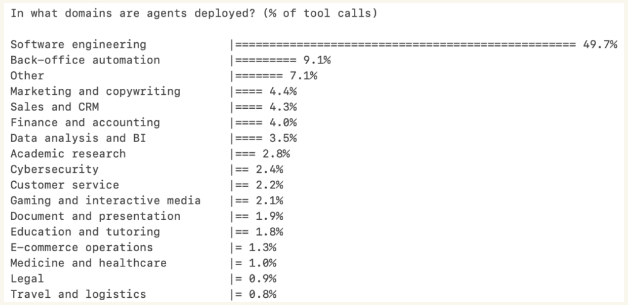
Source: Sequoia Capital, "Services: The New Software," March 2026 (Link)
Sequoia's framing helps explain why. AI is best at intelligence work — applying complex rules consistently across structured data — and leaves judgement work to humans. By that logic, finance should be near the front of the line. Most of what finance teams do day-to-day is intelligence work: reconciling records, producing rollups, calculating metrics, drafting first-pass analyses.
So why is finance at 4%? Because intelligence work only works when the data underneath is clean enough for an AI to apply rules to it. And most finance data isn't.
The typical finance tech stack has always been a patchwork. An ERP managing the books. A CRM tracking customer activity. A billing system processing revenue. Maybe a data warehouse trying to stitch some of it together. Each system captures a slice of the business. None of them talk to each other and agree by default.
The result is a set of challenges that compound on each other:
Experienced finance teams have learned to navigate all of this. They know where the discrepancies are, which numbers to reconcile before they go anywhere near a board deck, which edge cases get handled which way. A skilled analyst carries an enormous amount of institutional context that makes the current setup work.
That institutional knowledge is exactly what AI doesn't have.
When you feed an AI model your financial data, it receives the raw output — not the context that makes it interpretable. Spreadsheets worked because humans carried that context. AI needs that context along with the structured, clean data to generate meaningful and accurate outputs.
When you add AI on top of messy data, you still get outputs that look right. That's the problem.
A well-prompted model produces clean, structured, authoritative-looking analysis regardless of what it's working with. It doesn't flag uncertainty the way a cautious analyst would. It doesn't know what it doesn't know about your business or your financial rules. Spreadsheets were fragile and time-consuming, but finance teams understood their failure modes — which numbers needed a reconciliation pass, which formulas to treat with skepticism. AI doesn't come with that shared understanding baked in.
This came up repeatedly at our CFO roundtables in New York and Toronto. One attendee articulated the concern better than most:
"You don't really have a way to know if AI outputs are right. Large language models are amazing at generating really convincing-sounding things, but they're designed to give you plausible answers, not necessarily accurate ones."
You see this most with complex, highly-custom analyses of metrics like ARR.
There is no single common ARR definition and calculation. Every company handles ramp periods, renewal grace periods, credits, and discounts differently. The definitions rhyme, but the details vary in ways that matter enormously. Feed a model that data without encoding those definitions, and it produces a confident ARR analysis that may be completely wrong for your business — and nothing in the output will tell you that.
Clean, governed, semantically correct data is the only thing that makes AI outputs trustworthy in finance. Without it, the confidence the AI model projects becomes the problem rather than the benefit.
AI-ready data in finance means something more specific than "clean."
It means your data is structured, daily updated, continuously governed and context-rich enough that a model can work with it reliably — without a human spending half the session explaining what the numbers actually mean.
Across the PE-backed CFOs we've worked with, six things have to be true:
None of this is unique to AI readiness. These are the same principles that have underpinned investor-grade data integrity for years. The difference is that AI makes the gaps impossible to hide.
And here's the part most finance teams underestimate: building this foundation is hard. Maintaining it — through new acquisitions, billing system changes, pricing model shifts, ARR definition updates — is where most foundations quietly degrade. AI-readiness isn't a project. It's an operating discipline. A financial cube isn't built once and left alone. It has to be maintained continuously.
The CFOs getting real value from AI in finance right now have one thing in common: better data. Driver analysis, board narrative generation, scenario forecasting — these use cases work when the underlying revenue and customer data is reconciled, governed, and means what you think it means. They fall apart when it isn't.
That's the practical case for the Perfect Cube. A unified, continuously reconciled revenue and customer dataset — with business logic encoded directly in the data — is what gives AI something solid to work with. Without it, you're investing in a capability your data foundation can't yet support.
The CFOs furthest along on this aren't necessarily the ones with the biggest tech budgets. They're the ones who treated the data foundation as the project, and the AI as what gets unlocked once it's in place.
Our guide, The PE-Backed CFO's Guide to an AI-Ready Revenue and Customer Intelligence, walks through exactly what that requires — drawing on experience with 100+ PE-backed finance leaders who have built this foundation and what they learned along the way.